1. What is a Biomass Wood Pellet Machine?
If you've been looking for a way to cut your fuel costs by 40–60% while helping the environment, a biomass wood pellet machine is probably the most practical answer available to Indian manufacturers today.
Simply put, a biomass wood pellet machine is an industrial compaction system that takes loose organic waste — sawdust, wood chips, rice husk, agro-residue — and compresses it under high pressure and heat into dense, cylindrical fuel pellets. These pellets are typically 6 to 12 mm in diameter and burn cleanly and efficiently, replacing diesel, LPG, or coal in boilers, furnaces, dryers, and industrial burners.
Think of it this way: loose sawdust that previously had no real market value gets transformed into a standardised, high-energy fuel product that industries are willing to buy. That's exactly why biomass pellet machines have taken off across India's manufacturing sector.
Energy Density
4,200–4,800 kcal/kg calorific value — comparable to lignite coal
Standard Size
6 mm, 8 mm, 10 mm, or 12 mm diameter pellets, 10–30 mm length
Moisture Content
Final pellets contain less than 10–12% moisture — ideal for clean combustion
Carbon Neutral
CO₂ released = CO₂ absorbed during plant growth — net-zero fuel
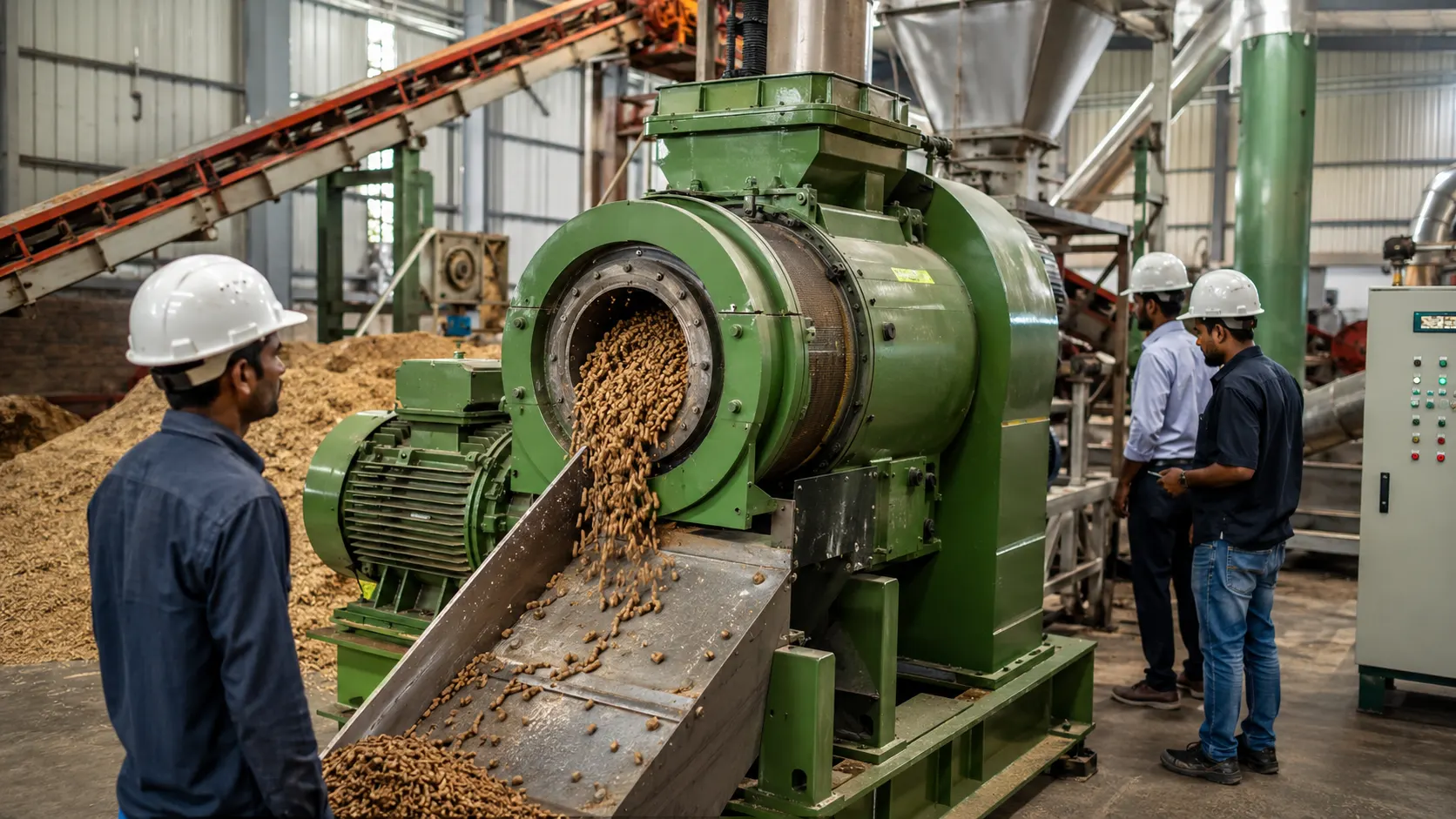
A biomass wood pellet machine in operation at an Indian manufacturing facility. Aryan Engineering, Pune supplies and installs similar systems across Maharashtra.
2. How Does a Biomass Pellet Machine Work? (Step-by-Step)
The pelletization process is more sensitive than it looks from the outside. It's not just "put in sawdust, get pellets." Each stage matters, and getting any one of them wrong — especially moisture content or particle size — can reduce pellet quality significantly. Here's the actual sequence:
Raw Material Collection & Preparation
Biomass waste — sawdust, wood chips, rice husk, crop residue — is collected and inspected. Large pieces are pre-crushed using a hammer mill or wood chipper to reduce particle size to 3–6 mm, which is the ideal feed size for most pellet dies.
Drying (Critical Stage)
This is where many operations trip up. The raw biomass must be dried to a moisture content of 10–15% before pelletization. Too wet and pellets crack. Too dry and the material won't bind properly. Rotary drum dryers or flash dryers are used at this stage.
Feeding into the Pellet Mill
Conditioned biomass is fed into the pellet mill through a variable-speed feeder that ensures a uniform, steady flow. Uneven feeding causes output fluctuations and increases die wear.
Compression & Pellet Formation
This is the heart of the machine. Press rollers force the biomass into the holes of the die under extreme pressure. The friction generates heat (80–120°C), which softens the natural lignin in the biomass — this acts as the binding agent without any chemical additives. The compressed biomass forms pellets as it exits the die holes.
Cutting to Length
As pellets exit the die, a rotating knife cuts them to the desired length — typically 10 to 30 mm. The knife position can usually be adjusted to change pellet length.
Cooling
Fresh pellets come out hot and slightly soft. A counter-flow pellet cooler drops the temperature to near-ambient and hardens the pellets. This step is often skipped by small operators — but it's essential for pellet quality and storage life.
Screening & Packaging
A vibrating screen removes fines and broken pellets. The sorted pellets are then either bagged in 25–50 kg sacks or stored in bulk silos, ready for sale or direct industrial use.
3. Types of Biomass Pellet Machines: Flat Die vs Ring Die
If you're buying a biomass pellet machine in India, you'll quickly realise there are two main types. The right choice depends entirely on your production scale, raw material, and budget. Here's a clear comparison:
| Feature | Flat Die Pellet Machine | Ring Die Pellet Machine |
|---|---|---|
| Capacity Range | 100 – 900 kg/hr | 600 – 2,000+ kg/hr |
| Best For | Small to medium scale | Industrial/large scale |
| Pellet Density | Moderate | High (harder, smoother pellets) |
| Price Range (India) | ₹1.5 – 8 lakh | ₹10 – 40+ lakh |
| Die Wear & Maintenance | Easy, low-cost replacements | Higher, but longer service life |
| Power Consumption | Lower (suitable for smaller units) | Higher, more efficient at scale |
| Raw Material Flexibility | Good — handles diverse inputs | Best with consistent wood feedstock |
| Automation Options | Manual to semi-auto | Fully automatic available |
| Ideal For | Startups, agro-waste units, farms | Established pellet manufacturers |
Which one should you choose?
If you're just starting out or processing sawdust and mixed agricultural waste at under 500 kg/hr, a flat die machine is the smarter first investment — lower capital cost, easier maintenance, and a shorter learning curve. Once you've built a market for your pellets and are running at capacity, upgrading to a ring die system makes economic sense.
For established manufacturers already running boilers at scale — say a dal mill dryer or a namkeen bhatti operation — a ring die machine gives you the consistency and output that justifies the investment quickly.
4. What Raw Materials Can You Use?
One of the biggest advantages of a biomass pellet machine is the sheer variety of raw materials it accepts. India produces over 120–150 million metric tonnes of biomass annually — much of it currently wasted or burned in fields. Here's what your machine can process:
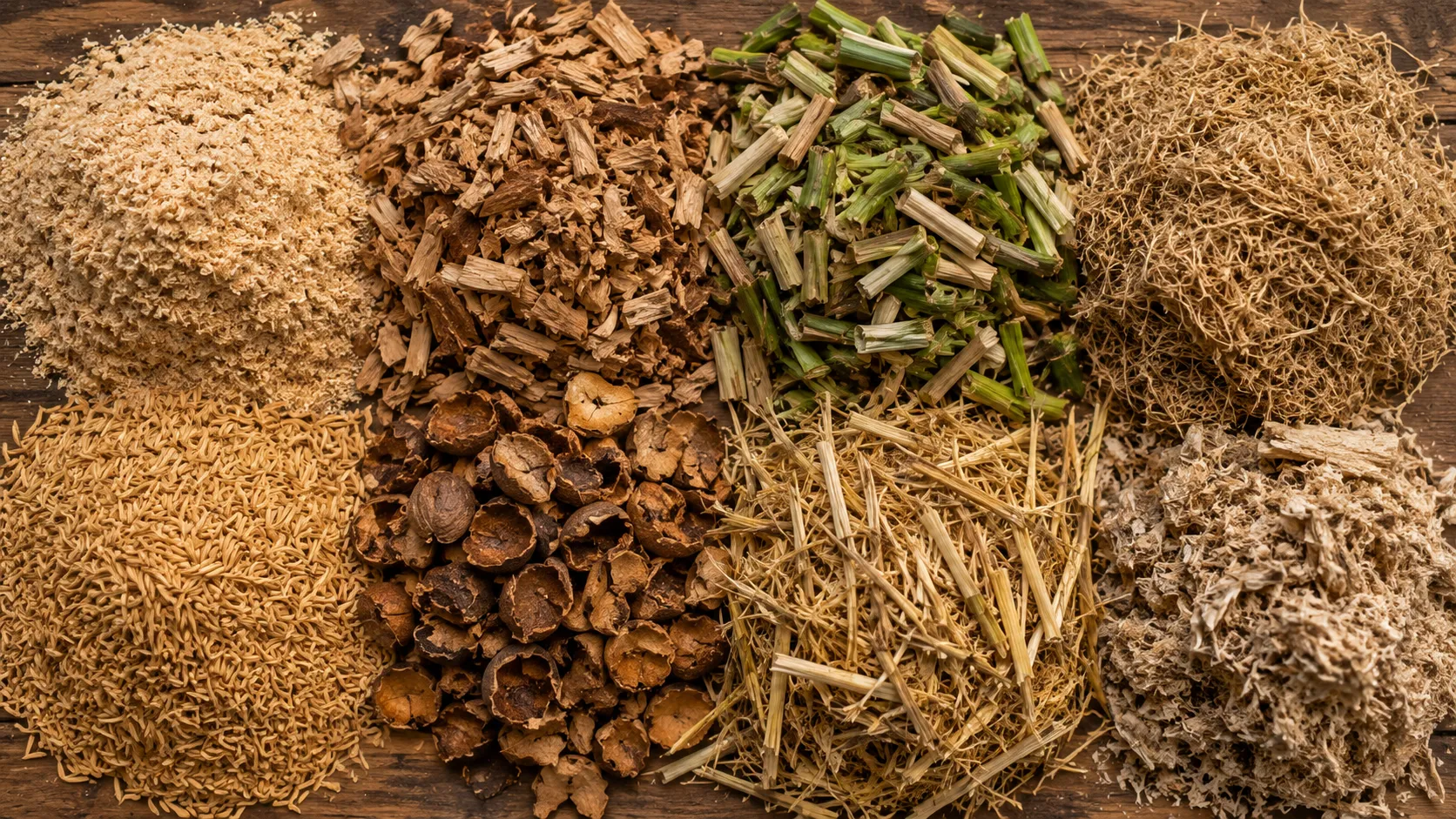
Common raw materials used in biomass pellet production across Indian industries — sawdust, wood chips, rice husk, groundnut shells, sugarcane bagasse, and wheat straw.
Wood-based materials
- Sawdust (most common, best quality pellets)
- Wood chips and shavings
- Tree branches, bark, and forestry waste
- Bamboo chips and waste
- Timber off-cuts from furniture manufacturers
Agricultural residues (agro-waste)
- Rice husk and paddy straw (Punjab, Haryana, UP)
- Wheat straw
- Sugarcane bagasse
- Cotton stalks
- Groundnut shells and mustard stalks
- Coconut shells (high calorific value, popular in South India)
- Corn cobs and corn stalks
5. Why Indian Industries Are Switching to Biomass Pellets
Let's be direct: the reason factories in Pune, Ahmedabad, Ludhiana, and across Maharashtra are switching to biomass pellet systems right now isn't just about being "green." It's mostly about money — and the numbers are hard to argue with.
40–60% Fuel Cost Savings
vs diesel, LPG, or furnace oil. Biomass pellets cost ₹6–10/kg vs diesel at ₹90+/litre.
Renewable & Reliable
India produces over 150 million tonnes of biomass annually — sustainable domestic supply.
Easy Retrofit
Biomass pellet burners can replace existing diesel/LPG burners without rebuilding the boiler.
Policy Push
MNRE mandates biomass co-firing at thermal power plants — creating massive demand.
Beyond the financials, biomass pellets produce significantly lower carbon emissions than fossil fuels. They're classified as carbon-neutral because the CO₂ released during combustion was originally absorbed by the plants when they were growing. This matters increasingly for companies with ESG targets or those exporting to European markets, where sustainability credentials are now a procurement requirement.
6. Which Industries Use Biomass Pellet Machines?
The short answer is: almost any industry that currently burns diesel, LPG, or coal for heat. Here's where biomass pellet machines are making the biggest impact across India right now:
- Food processing (Namkeen, Farsan, Snacks): Replace diesel burners in bhattis and batch fryers. One of the fastest-growing segments in Maharashtra and Gujarat.
- Dal mill drying: Hot air dryers running on biomass pellets cut operating costs dramatically vs LPG.
- Boiler heating (textiles, chemicals, pharma): Pellet-fired boilers deliver consistent steam generation at lower cost.
- Aluminium melting furnaces: High-temperature applications where pellets deliver sustained, controllable heat.
- Brick kilns & ceramics: Replacing coal with pellets for cleaner, more uniform firing.
- Hotels & commercial kitchens: Industrial cooking ranges and bulk water heating.
- Agricultural drying (grain, spices, tobacco): Hot air pellet dryers are increasingly popular for post-harvest processing.
- Power plant co-firing: NTPC and state utilities now mandating 5–10% biomass co-firing with coal.
7. Biomass Pellet Machine Price in India (2026)
Here's what the market looks like right now. These are realistic price ranges based on current manufacturer listings and IndiaMart data — not promotional figures:
| Machine Type | Capacity | Approximate Price (INR) | Best For |
|---|---|---|---|
| Small Flat Die | 100 – 200 kg/hr | ₹1.5 – 3 lakh | Startups, small farms |
| Medium Flat Die | 200 – 500 kg/hr | ₹3 – 8 lakh | Medium agro-waste units |
| Small Ring Die | 500 – 800 kg/hr | ₹10 – 18 lakh | Dedicated pellet plants |
| Industrial Ring Die | 800 – 2,000 kg/hr | ₹20 – 40 lakh | Large manufacturers |
| Complete Pellet Plant (turnkey) | 1 – 5 TPH | ₹40 – 1.5 crore+ | Commercial pellet producers |
8. Government Subsidies & Schemes for Biomass Pellet Machines (2026)
This is the part most buyers miss. There's real government money available for setting up biomass pellet production units in India. Here are the key schemes worth knowing:
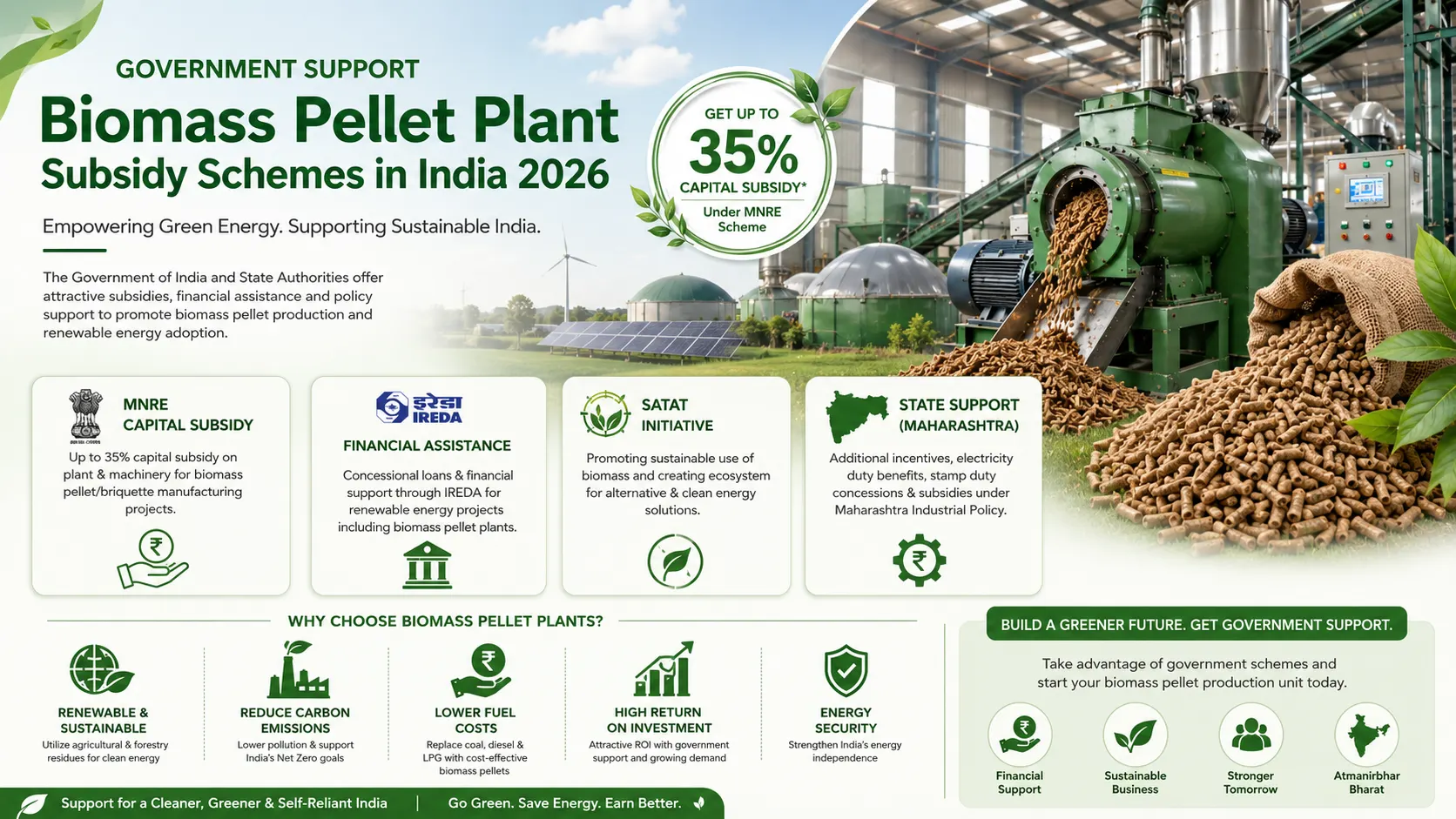
Indian government schemes supporting biomass pellet plant investments in 2026 — MNRE capital subsidy up to 35%, IREDA loans, SATAT initiative, and Maharashtra state support.
MNRE Capital Subsidy
The Ministry of New and Renewable Energy (MNRE) offers up to 35% capital subsidy for setting up biomass pellet and briquette manufacturing plants. This applies to plant and machinery, and can significantly reduce your initial investment. Maharashtra-based manufacturers should apply through MEDA (Maharashtra Energy Development Agency).
IREDA Financial Assistance
The Indian Renewable Energy Development Agency (IREDA) provides concessional loans and financial assistance specifically for biomass pellet production facilities. Low interest rates and flexible tenures make this a practical option for first-time investors.
SATAT Scheme
The Sustainable Alternative Towards Affordable Transportation (SATAT) initiative, while primarily focused on compressed biogas, has created an entire ecosystem for biomass utilisation — including pellet feedstock — that indirectly supports pellet plant viability.
State-Level Grants (Maharashtra)
Maharashtra has its own set of incentives for renewable energy manufacturing units, including reduced electricity tariffs for green energy production facilities and additional subsidies on plant and equipment under the Maharashtra Industrial Policy.
For exact eligibility and application procedures, it's best to consult directly with your machine manufacturer or a MNRE-registered consultant — these schemes have specific criteria that change each financial year.
9. How to Choose the Right Biomass Pellet Machine for Your Business
With so many options in the market — from imported Chinese machines to established Indian manufacturers — choosing the right one isn't as simple as picking the cheapest price. Here's what actually matters:
Step 1: Know your raw material first
Your feedstock determines the die specification, machine type, and pre-processing equipment you'll need. Sawdust and wood waste are forgiving. Rice husk and hard agro-waste need specific die configurations. Don't let a salesperson skip this question.
Step 2: Size the machine to your actual production need
Bigger isn't always better. A 1,000 kg/hr machine running at 40% capacity is less efficient than a 400 kg/hr machine running at 90%. Calculate your realistic daily operating hours and target monthly output before deciding on capacity.
Step 3: Ask about after-sales support
The die and rollers are wear parts — they need regular replacement. If your supplier is 1,000 km away or takes 3 weeks to ship spares, your production halts cost you far more than you saved buying cheaper. Local manufacturers like Aryan Engineering in Pune offer faster turnaround for Maharashtra-based industries.
Step 4: Request a material trial before purchase
Any reputable manufacturer should be willing to run your raw material through their machine and show you the pellet output. If they're reluctant to do this, that's a red flag.
Step 5: Compare total cost of ownership, not just machine price
Factor in: installation charges, power consumption (kW/hr per tonne of pellet), die replacement cost and frequency, maintenance downtime, and whether training is included.
Frequently Asked Questions (FAQ)
These are the questions we hear most often from industries across Pune and Maharashtra who are considering their first biomass pellet machine.
Ready to Set Up Your Biomass Pellet Machine?
Talk to our engineers at Aryan Engineering, Pune. We'll help you choose the right machine capacity, raw material setup, and calculate your exact ROI — no obligation, no sales pressure. Just straight answers.